Lagoons of Carlsbad
The City of Carlsbad states that its three lagoons cover more than 1,000 acres and provide nature preserves, hiking trails and water recreation areas for the public[1]. Each lagoon has a distinct character: Buena Vista is a freshwater ecological reserve[2], Agua Hedionda supports active boating and aquaculture[4], and Batiquitos is a tidal estuary reopened to the ocean after a 1990s restoration project[5].
The lagoons also figure in the city's early development history; 19th-century land companies acquired large tracts around Buena Vista, Agua Hedionda and Batiquitos lagoons for speculative town-building, and the 1952 incorporation boundary zigzagged through Buena Vista Lagoon[8][9][10].
Overview
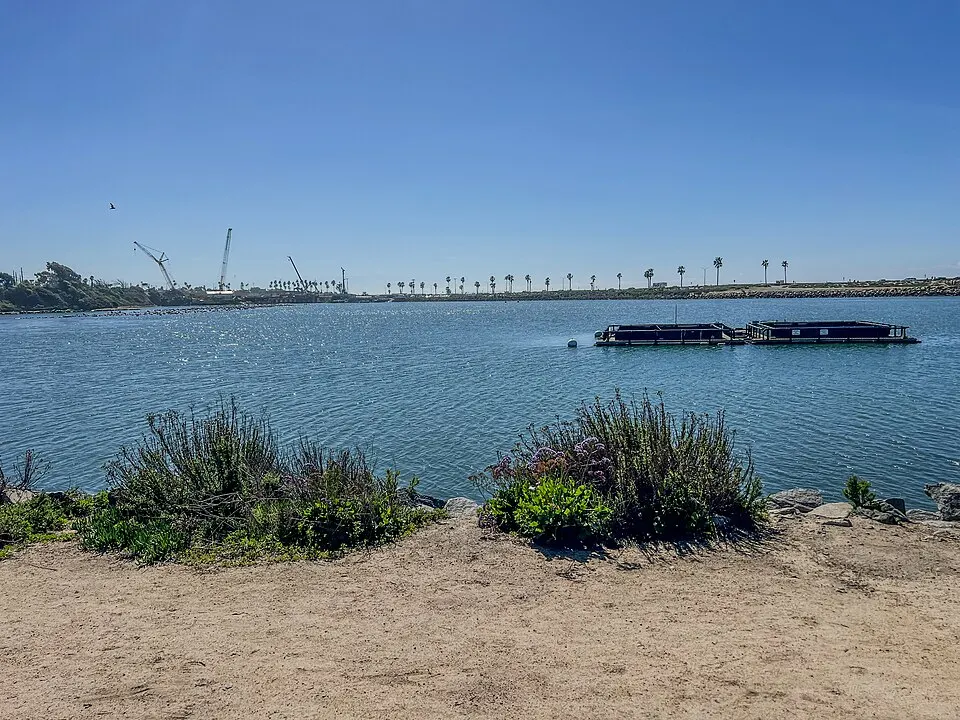

Carlsbad contains three coastal lagoons—Buena Vista, Agua Hedionda and Batiquitos—that together cover more than 1,000 acres and include nature preserves, hiking trails and water recreation areas, according to the City of Carlsbad[1]. The lagoons provide open space for the public to observe nature, exercise and take in coastal views[1]. Each lagoon is managed differently: Buena Vista is a freshwater ecological reserve, Agua Hedionda supports active boating and industrial uses, and Batiquitos is a tidal estuary reopened to the ocean through a restoration project[2][4][5].
The lagoons have also shaped the region's development history. Early Carlsbad land holdings extended between Buena Vista and Agua Hedionda lagoons, acquired by Gerhard Schutte as part of the land that became the town site[8]. The coastal area around Batiquitos Lagoon was the site of a separate, unsuccessful 1880s town venture by the La Costa Land and Town Company, which purchased hundreds of acres on both sides of the lagoon before the project failed for lack of water supply[9]. When Carlsbad incorporated in 1952, its proposed northern boundary zigzagged through Buena Vista Lagoon, and its boundary also touched Agua Hedionda Lagoon near the Encina power plant site[10].
Buena Vista Lagoon
Buena Vista Lagoon, whose name is Spanish for “good view,” is a freshwater lagoon lying on the border between Carlsbad and Oceanside and is owned by the California Department of Fish and Wildlife[2]. The City of Carlsbad lists the lagoon at 350 acres[2], while Wikipedia gives an area of 223 acres of wetland habitat[3]. It was designated as California's first ecological reserve in 1969[2].
The lagoon lies on the Pacific Flyway migration route, and millions of birds pass through during winter and summer migrations[2]. The City of Carlsbad reports more than 103 bird species, 18 mammals, and 14 amphibians and reptiles living in and around the lagoon, with more than 235 bird species spotted overall, including the California Quail, Vermillion Flycatcher and Great Blue Heron[2]; Wikipedia similarly cites at least 103 bird species, 18 mammals and 14 amphibians and reptiles[3]. The lagoon is home to the Buena Vista Audubon Society Nature Center and is also the focus of the nonprofit Buena Vista Lagoon Foundation[3].
Public viewing points include Maxton Brown Park on Laguna Avenue and State Street, the Ecological Wildlife Viewing Area on Jefferson Street and Marron Road, and the Buena Vista Audubon Society Nature Center on Coast Highway in Oceanside[2]. A Buena Vista Joint Powers Committee, made up of two Carlsbad City Council members and one resident, coordinates with Oceanside representatives on watershed matters[2]. The San Diego Association of Governments has been conducting an environmental study of future lagoon enhancements[2], and as of early 2018 there had been discussion, but no definitive plans, about whether to keep the lagoon freshwater or open it to saltwater mixing as with Agua Hedionda[3].
Agua Hedionda Lagoon
Agua Hedionda Lagoon connects to the Pacific Ocean between Tamarack Avenue and Cannon Road and consists of three interconnected lagoons divided by the Interstate 5 freeway and a railroad bridge, according to the City of Carlsbad[4]. The 66-acre outer lagoon allows shore fishing and supplies intake water for the Carlsbad Desalination Plant, and is leased to an aquaculture company that cultivates shellfish[4]. The 27-acre middle lagoon hosts the North Coast YMCA Aquatic Park, and the 295-acre inner lagoon is used for boating[4]. The Agua Hedionda Lagoon Foundation, a nonprofit operating a Discovery Campus and education programs, describes the lagoon as about 400 acres[11].
Active recreational uses such as boating, water skiing, wakeboarding, personal watercraft use, sailing, windsurfing and fishing are allowed in designated areas, and operating a vessel on the lagoon requires meeting requirements and purchasing a permit issued by the city at the Harding Community Center[4]. Wikipedia likewise describes stand-up paddleboarding, kayaking, wakeboarding, waterskiing, jet skiing and wave running as common uses, noting the lagoon is sometimes informally called the “Carlsbad Lagoon”[12]. Fishing is popular but restricted to designated areas, including the lower east end, due to algae in other parts of the lagoon, and boats are not permitted to anchor in order to protect the natural environment[12]. A fishing license is required for those 16 and older, and shoreline fishing is allowed from public access points while fishing from a vessel is limited to passive recreation areas[12].
Stewardship of much of the lagoon is held by NRG Energy because of its ownership of the former Encina Power Station, while the city notes the lagoon itself is owned by Cabrillo Power 1 LLC[12][4]. In November 2000 the lagoon was designated a critical habitat for the tidewater goby[12]. The Agua Hedionda Lagoon Discovery Center, at 1580 Cannon Road, offers public programs, exhibits, lectures and festivals[4]. The cities of Carlsbad and Vista, San Diego County and other agencies in the watershed group monitor water quality; a year-long study completed in September 2022 found that bacteria levels in the lagoon were below state water quality objectives and that the water was safe for recreational use[4].
Batiquitos Lagoon
Batiquitos Lagoon is a coastal wetland and estuary located between southern Carlsbad and Encinitas[6]. The City of Carlsbad lists the lagoon at 561 acres[5], while Wikipedia gives 610 acres with a drainage basin of about 55,000 acres fed primarily by San Marcos Creek and Encinitas Creek[6]. It is protected by municipal ordinances as a game sanctuary and bird estuary and is owned by the California Department of Fish and Wildlife, which designated it an Ecological Reserve in 1983[5][7].
The lagoon was originally open to the ocean, but construction of transportation corridors and other development caused sediment to close it over time[5]. In 1997, the Port of Los Angeles and other agencies began a restoration project that returned the lagoon to a fully tidal, saltwater system, increasing fish populations from about five species to more than sixty-five[6]. The City of Carlsbad describes the mid-1990s enhancement project, conducted with the Port of Los Angeles and other cooperating agencies, as reopening the lagoon to the ocean[5].
The lagoon supports many wildlife species, with endangered birds such as the Snowy Plover, California Least Tern and Clapper Rail observed there[5]. A public walking and hiking trail runs along the north shore; the city lists it as currently 2.7 miles with additional segments planned, while Wikipedia describes a 1.75-mile nature trail that is generally wheelchair and stroller friendly[5][6]. The Batiquitos Lagoon Foundation operates a nature center at 7380 Gabbiano Lane offering docent-led walks and self-guided nature pamphlets, and also co-sponsors Club Pelican, a nature and arts summer camp, with the City of Carlsbad[5]. Evidence of human habitation around the lagoon dates back over 9,000 years, and the name “Batiquitos” derives from a Spanish term for a watering hole dug in a stream bed[6]. The area was opened to homesteading in the 1870s, and 1880s development efforts around the lagoon ultimately failed for lack of adequate water supply[9].
Recreation rules
Rules vary by lagoon. On Agua Hedionda Lagoon, boats, personal watercraft and paddleboards are allowed, and permits are required to operate any vessel; annual and daily permits are issued by the City of Carlsbad at the Harding Community Center[1][4]. Permitted craft include jet skis, power boats and passive vessels such as sailboats and kayaks, and visitors are advised to review posted rules and regulations before visiting[4]. Fishing is restricted to designated areas due to algae growth elsewhere in the lagoon, anchoring is prohibited to protect the environment, and a license is required for anglers 16 and older[12].
At Batiquitos Lagoon, the trail and picnic tables are open from dawn to dusk, while the Nature Center restroom and viewing deck are typically open from 9 a.m. to 3 p.m., subject to volunteer availability[5]. Dogs are allowed on the trail but must be leashed at all times[5]. Fishing with a valid license is permitted only at the rock jetties near South Ponto Beach and under the Interstate 5 bridge, consistent with the California Department of Fish and Wildlife's rule limiting fishing to designated areas under the I-5 and Carlsbad Boulevard bridges and prohibiting fishing east of I-5[5][7]. The Ecological Reserve additionally prohibits horses, bicycles and drones without a special use permit, and notes that public parking at the reserve is very limited[7].
Buena Vista Lagoon, as an ecological preserve, is primarily managed for wildlife viewing rather than active recreation, with public access focused on viewing points such as Maxton Brown Park, the Ecological Wildlife Viewing Area and the Audubon Society Nature Center[2]. Across all three lagoons, the City of Carlsbad frames recreation as part of broader open-space and conservation goals, encouraging activities such as hiking and water recreation while emphasizing habitat protection[1].
Entries in this section
- Batiquitos Lagoon — Batiquitos Lagoon is a tidal coastal wetland and ecological reserve in southern Carlsbad, managed by CDFW with a shoreline trail and nature center.
- Agua Hedionda Lagoon — Agua Hedionda Lagoon is a three-part coastal lagoon in Carlsbad, California, used for boating, fishing, aquaculture, and desalination intake.
Common questions
Which lagoon in Carlsbad allows boating?
Agua Hedionda Lagoon allows boating, water skiing, wakeboarding, personal watercraft use, sailing and windsurfing in designated areas, with a permit required to operate a vessel[4].
How big are Carlsbad's lagoons?
The City of Carlsbad lists Buena Vista at 350 acres, Agua Hedionda divided into 66-, 27- and 295-acre sections, and Batiquitos at 561 acres[2][4][5]; Wikipedia gives slightly different figures of 223 acres for Buena Vista and 610 acres for Batiquitos[3][6].
Can visitors fish in the lagoons?
Fishing is allowed with a license in designated areas: shoreline fishing at Agua Hedionda, rock jetties at Batiquitos, and under certain bridges at the Batiquitos Lagoon Ecological Reserve[12][5][7].
Are dogs allowed on lagoon trails?
Dogs are allowed on the Batiquitos Lagoon trail if leashed, and must be under owner's control at the Batiquitos Lagoon Ecological Reserve[5][7].
Is the water quality in Agua Hedionda Lagoon safe for recreation?
A 2022 study by the city and other agencies found bacteria levels in Agua Hedionda Lagoon below state water quality objectives, indicating the water is safe for recreational uses[4].
Related topics
- Geography of Carlsbad
- Beaches of Carlsbad
- Agua Hedionda Lagoon
- Batiquitos Lagoon
- Parks and recreation in Carlsbad
- Trails in Carlsbad
- Claude "Bud" Lewis Carlsbad Desalination Plant
- History of Carlsbad
References
All sources retrieved November 2026.
- ^ a b c d e f g h "cc_lagoons". City of Carlsbad. Retrieved November 2026.
- ^ a b c d e f g h i j k l m n "cc_buenavista". City of Carlsbad. Retrieved November 2026.
- ^ a b c d e f "Buena Vista Lagoon (Wikipedia)". Wikipedia. Retrieved November 2026.
- ^ a b c d e f g h i j k l m n o p "cc_aguahed". City of Carlsbad. Retrieved November 2026.
- ^ a b c d e f g h i j k l m n o p "cc_batiquitos". City of Carlsbad. Retrieved November 2026.
- ^ a b c d e f g "Batiquitos Lagoon (Wikipedia)". Wikipedia. Retrieved November 2026.
- ^ a b c d e f "Batiquitos Lagoon Ecological Reserve". California Department of Fish and Wildlife. Retrieved November 2026.
- ^ a b "Between Germany and Carlsbad". San Diego History Center, Journal of San Diego History. Retrieved November 2026.
- ^ a b c "Windowns on the Past - An Ilustrated History of Carlsbad, California by Susan Schnebelen Gutierrez -- 1880s and 1890s". Carlsbad Historical Society. Retrieved November 2026.
- ^ a b "Windowns on the Past - An Ilustrated History of Carlsbad, California by Susan Schnebelen Gutierrez -- Battle for Incorporation". Carlsbad Historical Society. Retrieved November 2026.
- ^ "Agua Hedionda Lagoon Foundation | Preserving the Lagoon". Agua Hedionda Lagoon Foundation. Retrieved November 2026.
- ^ a b c d e f g "Agua Hedionda Lagoon (Wikipedia)". Wikipedia. Retrieved November 2026.