Agua Hedionda Lagoon
Agua Hedionda Lagoon, whose Spanish name means “stinking water” or “fetid water,” is one of three lagoons in Carlsbad along with Batiquitos Lagoon and Buena Vista Lagoon[2][3][7]. The lagoon is divided into an outer, middle, and inner section covering roughly 66, 27, and 295 acres respectively, and supports boating, water skiing, windsurfing, fishing, and aquaculture, alongside its role supplying intake water to a desalination plant[1].
Stewardship of much of the lagoon has historically been tied to the former Encina Power Station, and the lagoon was designated critical habitat for the tidewater goby in November 2000[3]. The nonprofit Agua Hedionda Lagoon Foundation, formed in 1990, operates a Discovery Campus offering educational programs about the roughly 400-acre lagoon[4].
Name
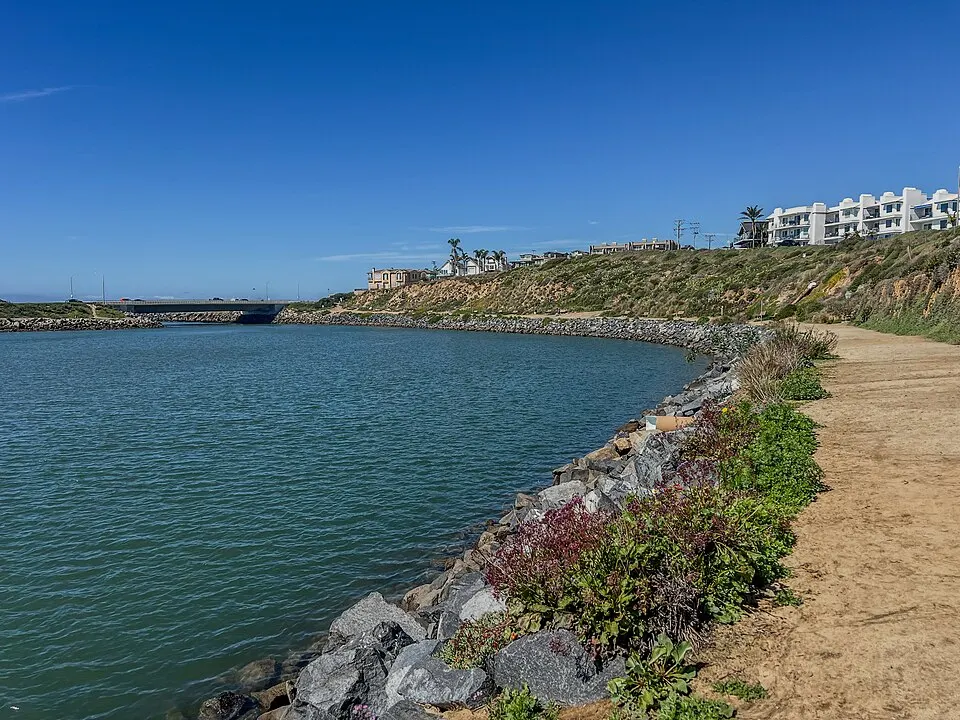

The name “Agua Hedionda” is Spanish for “fetid water” or “stinking water”[3][2]. The name derives from the historic Rancho Agua Hedionda, a 13,311-acre Mexican land grant given in 1842 by Governor Juan Alvarado to Juan María Marrón, which surrounded the lagoon and extended along the coast from present-day Carlsbad to Leucadia[2]. Before the twentieth century the lagoon’s mouth was not kept continuously open to the Pacific, and at low tide the enclosed water could become a stagnant, foul-smelling pool, a condition that is sometimes cited as the origin of the “stinking water” description[5]. Within Carlsbad the lagoon is also occasionally referred to as the “Carlsbad Lagoon” because of its location within city limits[3].
Geography
Agua Hedionda Lagoon is connected to the Pacific Ocean between Tamarack Avenue and Cannon Road and is fed by Agua Hedionda Creek[1][3]. It is composed of three interconnected sections, divided by Interstate 5 and a railroad bridge: a 66-acre outer lagoon adjacent to the ocean, a 27-acre middle lagoon, and a 295-acre inner lagoon, according to the City of Carlsbad[1]. The Agua Hedionda Lagoon Foundation describes the lagoon more broadly as covering about 400 acres[4][8]. It is one of three lagoons within the city, alongside Batiquitos Lagoon and Buena Vista Lagoon, which together with Agua Hedionda cover more than 1,000 acres of open space in Carlsbad[7].
In November 2000, Agua Hedionda Lagoon was designated as critical habitat for the tidewater goby[3]. The lagoon has historically required periodic dredging to maintain its connection to the ocean; dredging has occurred every two to four years since 1954, removing roughly 500,000 cubic yards of sand that is redistributed to nearby beaches[3]. Before dredging began, the lagoon was not connected to the Pacific Ocean, and without continued dredging it would revert to a pre-1952 mudflat[3][9]. Dredging was originally funded by the Encina Power Station and was later taken over by the operator of the Carlsbad Desalination Plant[3][9]. Portions of the original Rancho Agua Hedionda land grant later became part of the area considered for the incorporation of the City of Carlsbad in 1952, with the proposed city boundary zigzagging near the lagoon[10].
Recreation
The lagoon supports a range of active and passive recreational uses, including boating, water skiing, wakeboarding, personal watercraft use, sailing, windsurfing, stand-up paddleboarding, kayaking and fishing in designated areas[1][3]. The inner, 295-acre section of the lagoon may be used for boating, while the middle lagoon is home to the North Coast YMCA Aquatic Park[1]. To operate a vessel on the lagoon, the City of Carlsbad requires an annual or daily permit, issued at the Harding Community Center, and permitted craft include jet skis, power boats, sailboats and kayaks[1][7].
Fishing is a popular activity, though boats are not permitted to anchor because doing so would disrupt the lagoon’s natural environment, and shoreline fishing is allowed from public access points while fishing from a vessel is restricted to designated passive recreation areas[3]. Anglers 16 and older are required to hold a fishing license, and California Fish and Game laws are enforced during fishing activity[3]. The lagoon sees most of its visitors in summer and also functions as a social gathering spot for events[3]. Several trails in Carlsbad run along the lagoon’s shoreline, including the Agua Hedionda North Shore Hubbs Trail, Harbor Drive, Bayshore Drive, Kelly Trail, Summerwind Trail and a trail near the Agua Hedionda Nature Center[11].
Agencies including the City of Carlsbad, the City of Vista, and San Diego County monitor water quality in the lagoon as part of the Agua Hedionda watershed group[1]. A year-long bacteria study completed in September 2022 found that Enterococcus levels in the lagoon were below state water quality objectives and that the water was safe for recreational uses under the conditions sampled[1].
Agua Hedionda Lagoon Foundation
The Agua Hedionda Lagoon Foundation is a 501(c)(3) nonprofit organization formed in 1990 by Carlsbad citizens with a stated mission to “energize people through education and outreach to preserve the Agua Hedionda Lagoon as an accessible and healthy watershed”[4]. According to the organization, it is not affiliated with or obligated to any government, religious, or for-profit entity, and its programs are supported by citizens, grants, members and donations[4].
The foundation operates the Discovery Campus at 1580 Cannon Road, described by the City of Carlsbad as the Agua Hedionda Lagoon Discovery Center, which offers exhibits, lectures and festivals related to the lagoon[1][4]. The Discovery Campus features hands-on exhibits, gardens and live animal ambassadors, and the foundation says it suggests a $15 donation per group while membership admission is complimentary[4]. According to Wikipedia, the center opened in 2006 and includes a California native plant garden amid coastal sage scrub habitat, along with an Environmental Stewardship School Program aimed at local third graders covering lagoon history, archaeology, Native American culture, and watersheds[3]. The foundation also recruits volunteers and interns for trail maintenance, event support, conservation projects and garden upkeep[4].
Power plant and desalination
The southern shore of the lagoon’s outer segment was the site of Encina Power Station, a natural gas and oil-fueled plant constructed in 1954 and owned by NRG Energy, which opened the lagoon to continuous tidal flow to serve as a once-through cooling system[5]. The plant ceased generating operations on December 11, 2018, and was gradually demolished between 2020 and 2022, later replaced by a 530-megawatt peaker plant known as the Carlsbad Energy Center[5]. Stewardship of much of the lagoon has been held by NRG Energy as a result of its former ownership of the power station, though the City of Carlsbad notes the lagoon is owned by Cabrillo Power 1 LLC[3][1].
In 2015, Poseidon Resources Corp. constructed the US$300 million Claude “Bud” Lewis Carlsbad Desalination Plant adjacent to the former power station site, designed to produce 50 million US gallons of drinking water per day, enough to supply about 100,000 homes[5][6]. The plant draws seawater through an intake on the shores of Agua Hedionda Lagoon, using about 100 million gallons of seawater a day, of which roughly half is converted to drinking water while the remainder, carrying the original salt and minerals, is returned to the ocean through the lagoon[8]. The San Diego County Water Authority has a 30-year water purchase agreement, approved November 29, 2012, to buy and distribute the plant’s water, which supplies about 10% of the region’s drinking water needs[6]. The plant’s outflow is combined with the former power station’s discharge for dilution, producing a final salt concentration about 20% higher than seawater, compared with roughly 50% extra salinity typical of many desalination plants[9]. Poseidon Water took over dredging responsibility for the lagoon from NRG Energy[9][3].
The outer lagoon also provides intake water for the desalination plant and is leased to an aquaculture company cultivating shellfish for market, while the lagoon more broadly supports two aquaculture operations: the Carlsbad Aqua Farm, which raises oysters and mussels, and the Hubbs-SeaWorld Institute, which operates a white seabass hatchery[1][3].
Common questions
What does “Agua Hedionda” mean?
The name is Spanish for “stinking water” or “fetid water,” tracing back to the historic Rancho Agua Hedionda land grant[2][3].
Can you boat on Agua Hedionda Lagoon?
Boating, water skiing, wakeboarding, sailing, and personal watercraft use are allowed in certain areas, with a permit from the City of Carlsbad required to operate any vessel[1].
Is the lagoon connected to the desalination plant?
The outer lagoon provides intake water for the Carlsbad Desalination Plant, which draws about 100 million gallons of seawater a day from the lagoon[1][8].
Who operates the Agua Hedionda Lagoon Discovery Center?
The Discovery Center, also called the Discovery Campus, is operated by the nonprofit Agua Hedionda Lagoon Foundation, formed in 1990[4].
Is the water in the lagoon safe for recreation?
A year-long bacteria study completed in September 2022 found that Enterococcus levels in the lagoon were below state water quality objectives, indicating the water is safe for recreational uses[1].
Related topics
- Lagoons of Carlsbad
- Batiquitos Lagoon
- Claude "Bud" Lewis Carlsbad Desalination Plant
- Beaches of Carlsbad
- Trails in Carlsbad
- Attractions in Carlsbad
- History of Carlsbad
- Geography of Carlsbad
References
All sources retrieved November 2026.
- ^ a b c d e f g h i j k l m n o p q r "cc_aguahed". City of Carlsbad. Retrieved November 2026.
- ^ a b c d e "Rancho Agua Hedionda (Wikipedia)". Wikipedia. Retrieved November 2026.
- ^ a b c d e f g h i j k l m n o p q r s t u v "Agua Hedionda Lagoon (Wikipedia)". Wikipedia. Retrieved November 2026.
- ^ a b c d e f g h i "Agua Hedionda Lagoon Foundation | Preserving the Lagoon". Agua Hedionda Lagoon Foundation. Retrieved November 2026.
- ^ a b c d e "Encina Power Station (Wikipedia)". Wikipedia. Retrieved November 2026.
- ^ a b c "cc_desal". City of Carlsbad. Retrieved November 2026.
- ^ a b c "cc_lagoons". City of Carlsbad. Retrieved November 2026.
- ^ a b c "Seawater Desalination - San Diego County Water Authority". San Diego County Water Authority. Retrieved November 2026.
- ^ a b c d "Claude "Bud" Lewis Carlsbad Desalination Plant (Wikipedia)". Wikipedia. Retrieved November 2026.
- ^ "Windowns on the Past - An Ilustrated History of Carlsbad, California by Susan Schnebelen Gutierrez -- Battle for Incorporation". Carlsbad Historical Society. Retrieved November 2026.
- ^ "cc_traillocs". City of Carlsbad. Retrieved November 2026.