History of Carlsbad
Early inhabitants and the Spanish era
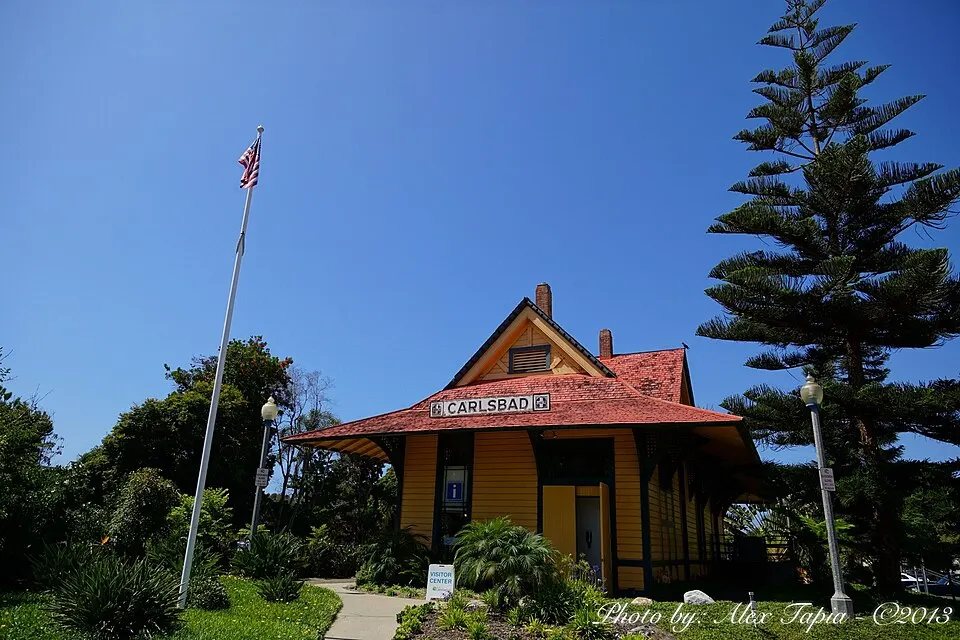

Before European contact, the area that became Carlsbad was home to Luiseño and Kumeyaay villages. A Luiseño village stood at the mouth of San Marcos Creek, called by the Kumeyaay "Ajopunquile," and a Kumeyaay village known as Hakutl was located in the Rancho Ponderosa area[1]. In 1769, the Spanish Portolá expedition, the first European land exploration of Alta California, camped on Buena Vista Creek and met native villagers there[1]. The expedition had trekked about 300 miles (480 km) from Velicatá before reaching the San Diego area[7].
Rancho period
During the Mexican period, in 1842, Governor Juan Alvarado granted the southern portion of present-day Carlsbad as the roughly 13,311-acre Rancho Agua Hedionda to Juan María Marrón[1][2]. The grant, whose name means "stinking water" in Spanish, extended along the coast from present-day Carlsbad to Leucadia and surrounded Agua Hedionda Lagoon[2]. After Marrón's death in 1853, his heirs leased the rancho to Francis Hinton in 1860; upon Hinton's death in 1870 it passed to his mayordomo Robert Kelly, and the Kelly family divided the rancho in 1896[2]. Land outside the rancho and the adjoining Marron property of Rinconada de Buena Vista later became the site of the town of Carlsbad[5].
Railroad and mineral water (1880s)
In the early 1880s, former sailor John A. Frazier settled on oceanfront land in the former Rancho Agua Hedionda and dug wells for his farm[1][3]. Sources describe Frazier arriving in the area at various dates, with the Los Angeles Times and the San Diego History Center placing his arrival in 1883[8][4], while Wikipedia dates his well-drilling to 1882[3]. His wells, reaching depths of roughly 400 to 510 feet, struck fresh water and then an artesian mineral spring[4][3]. Frazier began offering the water to passengers at the California Southern Railroad stop that became known as Frazier's Station[1][8].
Analysis found the water chemically similar to that of the renowned Well Number Nine at the spa of Karlsbad in Karlovy Vary, Bohemia (in what is now the Czech Republic), prompting the eventual naming of the town[1][5]. In 1886, German-born merchant Gerhard Schutte, together with Samuel Church Smith, D. D. Wadsworth and Henry Nelson, formed a real-estate venture variously called the Carlsbad Land and Mineral Water Company or Carlsbad Land and Water Company[1][5][4]. The company purchased land from Frazier at about $40 an acre, assembling roughly 400 acres between Buena Vista and Agua Hedionda lagoons[4][5][8]. Frazier was retained as water superintendent[4][5]. A nationally circulated eight-page pamphlet promoted the water and climate, with the Golden Era magazine predicting Carlsbad would occupy "a foremost place among the great sanitariums of the world"[4][8]. By 1887 the population reached about 300, and the town had its own newspaper, telegraph and post offices, a school, a small hotel, and an 85-room Carlsbad Hotel that opened amid the bursting real-estate boom[5][8][3]. That hotel burned down in 1896[5][8][3]. A separate development effort by the La Costa Town and Land Company, formed in 1886 near Batiquitos Lagoon, failed for lack of an adequate water supply and the area remained sparsely populated until the La Costa Resort was developed in the 1960s[5].
Twentieth century: agriculture and the Barrio
By the end of 1887, land prices fell throughout San Diego County, but the community survived on its fertile agricultural lands, as citrus fruits, avocados and olives were developed on the landscape[1]. Due to confusion with Carlsbad, New Mexico, the town's name was changed to "Carl" in 1907 before reverting to Carlsbad in 1917 amid local sentiment[3]. In 1929, after the paving of Highway 101, construction began on the Spanish-Revival Carlsbad Mineral Springs Hotel & Spa, which opened May 29, 1930, across from the original mineral springs site[3]. In the early 20th century, Latino residents settled an area near downtown bordered by Carlsbad Village Drive, Tamarack Avenue, Interstate 5 and the railroad tracks, now known as the Barrio[1]. Mineral water popularity continued for decades until the Great Depression, after which the wells fell into disrepair and were lost for about sixty years before later restoration[3].
Incorporation (1952)
In 1952, the neighboring city of Oceanside sought to annex a significant stretch of coastal Carlsbad, reportedly in part to secure the Encina Power Plant within its own boundaries[1][6]. On May 2, 1952, the annexation vote failed in a 45-45 deadlock[6]. Following that defeat, Carlsbad Chamber of Commerce board president R. R. "Red" Robinson led a drive to incorporate the community[6]. On February 19, 1952, the County Boundary Commission had accepted an incorporation plan covering about seven square miles, including part of the original Rancho Agua Hedionda and the downtown area developed by the Carlsbad Land and Water Company, though it excluded the non-contiguous North Carlsbad (Fire Mountain) area[9]. Incorporation Committee Chair Colonel Gronseth and others held informational meetings through March 1952 to advocate for the measure[9]. A vote was held on June 24, 1952, and incorporation was approved by a narrow margin of 781 to 714[6]. At incorporation the city covered about 7.5 square miles and had 6,963 residents[6].
Postwar growth
City Council members elected after incorporation chose the first mayor, Dewey McClellan, a former Chamber of Commerce board president whose father-in-law Roy Chase had founded the Chamber in 1923[6]. The city's first community-wide mayoral election was held in 1966, when Bill Atkinson Jr., elected to city council in 1964, became the first directly elected mayor[6]. Upon incorporation in July 1952, the city hired its first police officer, Chief Max Palkowski, who initially worked alone from a desk at the State of California Parks and Recreation Department and used his own car as the first police vehicle[10]. The department grew gradually, adding an officer in September 1952, two more officers and its first police car in January 1953, and roughly one additional officer each fiscal year afterward[10]. The single-runway Palomar Airport opened in 1959 after San Diego County officials decided to replace Del Mar Airport[1][11]. The airport was annexed to the City of Carlsbad in 1978 and renamed McClellan–Palomar Airport in 1982 after local civic leader Gerald McClellan[1][11]. See McClellan-Palomar Airport.
Recent history
Carlsbad has pursued open-space and growth-management planning since the 1980s, including a Citizens Committee for the Review of the Land Use Element in 1985, a Growth Management Program and Citywide Facilities and Improvements Program in 1986, and a Citizens Committee for Open Space in 1988–1989[12]. A 1992 Open Space and Conservation Resource Management Plan called for a comprehensive open space system, and a 1994 General Plan element guided further protection[12]. In 2002, voters approved Proposition C, authorizing more than $1 million in City Council spending to acquire open space and build trails; as of 2022 the city had spent $4.2 million on related projects, including the South Shore Agua Hedionda Lagoon Trail and Lake Calavera Trails[12].
In 1993, restoration of Frazier's original mineral well began, led by Ludvik Grigoras, a native of Karlovy Vary, and the mineral springs reopened in a ceremony on July 24, 1994, after 110 years, with water later bottled again as Carlsbad Alkaline Water[3]. On March 20, 1999, Legoland California opened in the city, the first Legoland park outside Europe, later expanding with a Sea Life aquarium in 2008, a water park in 2010, and two on-site hotels[13]. As of the 2020 census, Carlsbad had a population of 114,746 and is described as a popular tourist destination home to many golf-industry businesses[1]. See Legoland California and Historic landmarks of Carlsbad for related sites.
Entries in this section
- Frazier's Well and Carlsbad mineral water — The story of John Frazier's 1883 artesian well, Frazier's Station, and how mineral water analysis linked Carlsbad, California to Karlsbad, Bohemia.
- Incorporation of Carlsbad (1952) — How Carlsbad, California became an incorporated city in 1952 after a disputed Oceanside annexation vote and a close 781–714 incorporation election.
- Historic landmarks of Carlsbad — An overview of Carlsbad, California's historic landmarks, including Alt Karlsbad, the Santa Fe Depot, Twin Inns, Magee House, and Leo Carrillo Ranch.
Common questions
Why is Carlsbad named after a European spa town?
Mineral water discovered in wells dug by John A. Frazier was found chemically similar to the water of the famed Karlsbad spa in Karlovy Vary, Bohemia, leading town founders to name the settlement Carlsbad[1][4].
When did Carlsbad become an incorporated city?
Voters approved incorporation on June 24, 1952, by a margin of 781 to 714, after a prior annexation attempt by Oceanside failed in a 45-45 deadlock[6].
Who was John A. Frazier?
Frazier was a merchant seaman and farmer who settled on oceanfront land in the former Rancho Agua Hedionda and whose well discoveries of mineral water led to the founding of Carlsbad[3][1].
What was Rancho Agua Hedionda?
It was a roughly 13,311-acre Mexican land grant given in 1842 to Juan María Marrón, extending along the coast and surrounding Agua Hedionda Lagoon[2].
When did Legoland California open?
Legoland California opened on March 20, 1999, becoming the first Legoland park outside Europe[13].
Related topics
- Incorporation of Carlsbad (1952)
- Frazier's Well and Carlsbad mineral water
- Historic landmarks of Carlsbad
- Agua Hedionda Lagoon
- The Barrio
- McClellan-Palomar Airport
- Legoland California
- La Costa
References
All sources retrieved November 2026.
- ^ a b c d e f g h i j k l m n o p q r s t "Carlsbad, California (Wikipedia)". Wikipedia. Retrieved November 2026.
- ^ a b c d e "Rancho Agua Hedionda (Wikipedia)". Wikipedia. Retrieved November 2026.
- ^ a b c d e f g h i j k "John A. Frazier (Wikipedia)". Wikipedia. Retrieved November 2026.
- ^ a b c d e f g h i "Between Germany and Carlsbad". San Diego History Center, Journal of San Diego History. Retrieved November 2026.
- ^ a b c d e f g h i "Windowns on the Past - An Ilustrated History of Carlsbad, California by Susan Schnebelen Gutierrez -- 1880s and 1890s". Carlsbad Historical Society. Retrieved November 2026.
- ^ a b c d e f g h i j "The Birth of a City | Carlsbad Chamber of Commerce". Carlsbad Chamber of Commerce. Retrieved November 2026.
- ^ a b "Portolá expedition (Wikipedia)". Wikipedia. Retrieved November 2026.
- ^ a b c d e f "Town of Water : Natural Springs of Carlsbad Originally Drew Settlers in 1880s - Los Angeles Times". Los Angeles Times. Retrieved November 2026.
- ^ a b "Windowns on the Past - An Ilustrated History of Carlsbad, California by Susan Schnebelen Gutierrez -- Battle for Incorporation". Carlsbad Historical Society. Retrieved November 2026.
- ^ a b "cc_police". City of Carlsbad. Retrieved November 2026.
- ^ a b "McClellan–Palomar Airport (Wikipedia)". Wikipedia. Retrieved November 2026.
- ^ a b c "cc_openspace". City of Carlsbad. Retrieved November 2026.
- ^ a b "Legoland California (Wikipedia)". Wikipedia. Retrieved November 2026.