Frazier's Well and Carlsbad mineral water
John A. Frazier, a former sea captain, settled on land near present-day Carlsbad Boulevard in the early 1880s and drilled wells seeking fresh water for his farm, striking an artesian spring and mineral water instead.[2][3] The settlement that grew around his water stop on the California Southern Railroad became known as Frazier's Station.[4][5]
Chemical analysis of the mineral water showed similarities to the famous waters of Well Number Nine at Karlsbad, Bohemia, prompting a group of investors to form the Carlsbad Land and Mineral Water Company and rename the town Carlsbad.[1][4] The original well site is preserved today beneath Alt Karlsbad, a replica Hanseatic-style building on Carlsbad Boulevard.[4][3]
John A. Frazier
Captain John Aldridge Frazier was born in Westerly, Rhode Island, and went to sea with his uncle at age thirteen, later serving as a merchant seaman after receiving his U.S. Seaman's Protection Certificate in 1855.[3] He married in Lake County, California in 1862 and later moved to Nye County, Nevada, where he served as a Justice of the Peace until 1868.[3] In 1881 he moved with his second wife and six children to the area that would become Vista, California, and applied to open a post office there, becoming Vista's first postmaster in October 1882.[3]
Frazier had earlier founded the Good Samaritan Mission in Los Angeles before moving south.[2] According to the Los Angeles Times, he came to the Carlsbad area in 1883 and settled on a government homestead, later deciding his well water had curative powers over his chronic rheumatism.[4] The 126-acre property he settled had originally been homesteaded by Lafayette Tunnison, who had hauled water three miles from Marron Gorge before selling to Frazier in 1883.[2] Frazier died in 1890 after moving to Los Angeles, according to the Carlsbad Historical Society, though Wikipedia gives his death date as July 16, 1899.[1][3]
The well and Frazier's Station
Seeking a more reliable water source than hauling water by cart, Frazier drilled wells on his property and tapped an artesian spring described as about 400 feet below the surface, with further drilling producing mineral water from an underground stream.[2] Wikipedia's biography of Frazier states he sank three wells in 1882 at depths of 415 feet, 450 feet, and 510 feet, finding both fresh water and two mineral-bearing artesian springs.[3]
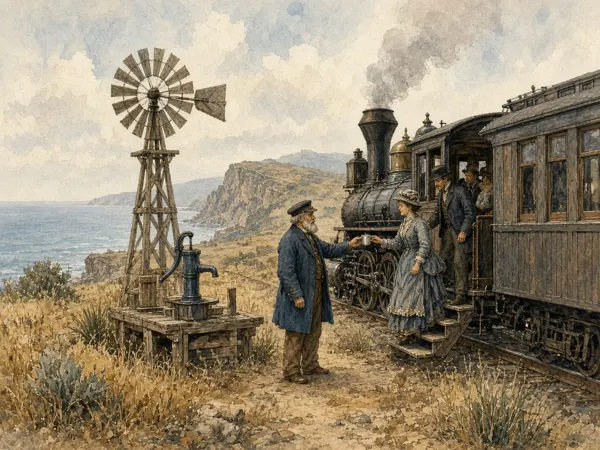
A well tower, described in one source as 510 feet and in another as 51 feet, rose behind Frazier's house and became a landmark for travelers between San Diego and Los Angeles.[2][3] When trains of the Western California line of the Santa Fe Railroad stopped to take on water, Frazier offered cups of mineral water to passengers, and a water barrel near the depot reportedly bore a sign inviting travelers to “alight, drink and be happy.”[2][4] The small village that formed around the depot became known as Frazier's Station.[4][5]
Comparison with Karlsbad's Well Number Nine
German-born merchant Gerhard Schutte, traveling through the region during the Southern California land boom of the 1880s, stopped at Frazier's Station in 1885 and became interested in the mineral water.[4][1] After gathering favorable information in 1886, Schutte joined with D. D. Wadsworth, Samuel Church Smith, and Henry Nelson to investigate the water further.[1]
Chemical analysis showed the local mineral water to be nearly identical in properties to the water drawn from Well Number Nine at the spa in Karlsbad, Bohemia, one of Europe's most renowned spa towns.[2][1][4] Karlovy Vary, the Czech name for the same city, was founded as a spa settlement around 1349, reportedly after Holy Roman Emperor Charles IV discovered a hot spring there and was healed of a leg injury.[6] The finding of similar mineral content struck Schutte as significant scientific authority for the new venture.[2]
Carlsbad Land and Mineral Water Company
Encouraged by the water analysis, Schutte, Wadsworth, Smith, and Nelson formed a real estate investment group in 1886 initially called the Carlsbad Land and Water Company, later cited as the Carlsbad Land and Mineral Water Company.[1][4] The company purchased 270 acres from Frazier along with 130 adjoining acres of coastal land at $40 an acre, totaling about 400 acres outside the Kelly Rancho Agua Hedionda land grant and the Marron property of Rinconada de Buena Vista.[1] The Los Angeles Times gives a similar account, stating Schutte bought Frazier's land for $40 an acre and partnered with others to acquire several hundred acres.[4]
Frazier was retained as general superintendent of the wells, since availability of water was considered an important selling point for western land.[1] The company commissioned an eight-page pamphlet distributed nationally, tracing the German spa's history from bath cure to internal remedy in 1522, claiming attendance of 30,000 visitors at the Bohemian spa by 1886, and urging readers to “Read, Ponder, Drink and Live.”[2] The company also invested $50,000 to build the Carlsbad Hotel, which opened but was destroyed by fire in 1896, after which land sales had already slowed considerably.[1][4]
By 1887, a year after the company's formation, the town's population reached 300 according to one account, though another source cites 200 at six months old, with a Wells Fargo Express and Post Office, a weekly newspaper called “The Sea Lion,” a Victorian-style train depot, and the La Palma Hotel.[1][2] The 1890s brought drought and economic depression, and the population reportedly dropped to 155, with the town nearly deserted and only six registered voters at one point.[1]
Alt Karlsbad and the site today
The mineral water trade declined with the Great Depression, and due to lack of maintenance the wells reportedly broke down and were lost for about sixty years.[3] In 1993, restoration of the well began under Ludvik Grigoras, a native of Karlovy Vary, who also redrilled another of Frazier's wells, which turned out to be naturally carbonated.[3][7] A 13-foot bronze statue of Frazier, created by Czech sculptor Vaclav Lokvenc, was shipped from Europe in 1994 and erected at the site.[3][8]
The mineral springs reportedly reopened after 110 years during a ceremony on July 24, 1994, and the water has since been bottled again as Carlsbad Alkaline Water.[3] Today the site of Frazier's original well is preserved beneath Alt Karlsbad, described as a replica of a German Hanseatic house, located on Carlsbad Boulevard.[4][5][3] A plaque and other historical markers are located within walking distance in the area known as Carlsbad Village, including St. Michael's By-the-Sea Episcopal Church, built in 1894.[3]
Carlsbad's 1991 sister-city relationship with Karlovy Vary grew in part from this shared mineral-water history, with the Carlsbad Sister City Ambassadors noting that Karlovy Vary was recognized by Holy Roman Emperor Charles IV in 1370 for the curative powers of its hot springs.[8][7]
Common questions
When did John Frazier drill his well in Carlsbad?
Accounts place Frazier's arrival and well-drilling in the early 1880s, with one source citing 1883 when he purchased the land and another describing three wells sunk in 1882.[2][3]
What was Frazier's Station?
Frazier's Station was the small settlement and railroad water stop that grew around John Frazier's well and home before the town was renamed Carlsbad.[4][5]
Why was the town named Carlsbad?
Chemical analysis showed the local mineral water was nearly identical to that of Well Number Nine at the spa in Karlsbad, Bohemia, leading the town's founders to adopt the name Carlsbad.[1][4]
What is Alt Karlsbad?
Alt Karlsbad is a replica German Hanseatic-style building on Carlsbad Boulevard that sits atop the site of John Frazier's original well and today houses a statue of Frazier and a history gallery.[4][3][9]
Is the mineral water still available today?
According to Wikipedia, the water has been bottled again as Carlsbad Alkaline Water since the well's restoration in the 1990s.[3]
Related topics
- History of Carlsbad
- Historic landmarks of Carlsbad
- Incorporation of Carlsbad (1952)
- Carlsbad Village
- Attractions in Carlsbad
- Notable people from Carlsbad
- Agua Hedionda Lagoon
- Beaches of Carlsbad
References
All sources retrieved November 2026.
- ^ a b c d e f g h i j k l m n o "Windowns on the Past - An Ilustrated History of Carlsbad, California by Susan Schnebelen Gutierrez -- 1880s and 1890s". Carlsbad Historical Society. Retrieved November 2026.
- ^ a b c d e f g h i j k l m "Between Germany and Carlsbad". San Diego History Center, Journal of San Diego History. Retrieved November 2026.
- ^ a b c d e f g h i j k l m n o p q r s t u "John A. Frazier (Wikipedia)". Wikipedia. Retrieved November 2026.
- ^ a b c d e f g h i j k l m n o p q r s "Town of Water : Natural Springs of Carlsbad Originally Drew Settlers in 1880s - Los Angeles Times". Los Angeles Times. Retrieved November 2026.
- ^ a b c d "Carlsbad, California (Wikipedia)". Wikipedia. Retrieved November 2026.
- ^ "Karlovy Vary (Wikipedia)". Wikipedia. Retrieved November 2026.
- ^ a b "Partnerské město Carlsbad, California, USA | Magistrát města Karlovy Vary". City of Karlovy Vary. Retrieved November 2026.
- ^ a b "CSCA History". Carlsbad Sister City Ambassadors. Retrieved November 2026.
- ^ "The 100-Year History of Carlsbad - Los Angeles Times". Los Angeles Times. Retrieved November 2026.