Historic landmarks of Carlsbad
The historic landmarks of Carlsbad largely trace to the town's founding in the 1880s around John Frazier's mineral well and to the Carlsbad Land and Water Company formed by Gerhard Schutte, D. D. Wadsworth, Samuel Church Smith and Henry Nelson[3][1]. Several buildings constructed by the town's founders survive, including homes now known as the Twin Inns and the Magee House[7][3]. The 1887 Santa Fe Depot and the Alt Karlsbad replica building, marking the site of Frazier's original well, remain landmarks downtown[4][1]. South of downtown, Leo Carrillo Ranch Historic Park preserves the adobe hacienda built by actor Leo Carrillo beginning in 1937[5][6].
Alt Karlsbad

Alt Karlsbad is a replica of a German Hanseatic-style building located on Carlsbad Boulevard, marking the site of John Frazier's original well[1][4]. Frazier tapped the well in the early 1880s, and analysis found its water shared chemical properties with that of the Karlovy Vary spa in Bohemia, which inspired the town's name[4][7]. A historical marker and plaque note the mineral spring site along the roadway historically known as Highway 101, now Carlsbad Boulevard, and nearby are eight other historical markers within the area known as Carlsbad Village[7].
Santa Fe Depot
The original Carlsbad station was built in 1887 by the California Southern Railroad, later part of the Atchison, Topeka and Santa Fe Railway[2]. The depot was used by the railroad until 1960 and was listed on the National Register of Historic Places in 1993 as the Carlsbad Santa Fe Depot[2][7]. It now serves as the city's visitor center, located at 400 Carlsbad Village Drive[2]. According to a 1987 Los Angeles Times account, the depot building housed the Carlsbad Convention and Visitors Bureau's Visitor Center, two blocks east of Carlsbad Boulevard between Grand and Elm avenues[4]. The site was later replaced in railroad service by the Carlsbad Village station, which remains a stop on the NCTD COASTER commuter rail line[8][9].
Twin Inns
The building now known as the Twin Inns was originally the home of Gerhard Schutte, a founder of the Carlsbad Land and Water Company[10][7]. Schutte and his wife Bertha moved to National City in 1910, and four years later their former home was converted into the Twin Inns Restaurant[10]. A second "twin," the home of co-founder D. D. Wadsworth, was never occupied by its original owner; it later served as temporary housing for newcomers and then as an annex to the Twin Inns before being demolished in 1956[10]. According to the 1880s history compiled by the Carlsbad Historical Society, a Victorian-themed home built by Schutte on Carlsbad Boulevard became what was at one point known as Neiman's Restaurant[3][4].
Magee House
The Magee House was originally the 1887 home of town co-founder Samuel Church Smith, described as a typical Midwestern-style house that included a snow porch[3]. It is now located in Magee Park on Beech Avenue and has served as a mini-museum operated by the Carlsbad Historical Society[4][3]. A 1987 account notes a Carlsbad Historical Society member staffed the house on Saturday afternoons, with weekday access available through the city's Parks Department[4]. Nearby in Magee Park are the Shipley-Magee Barn, built by later owners of the house, and a roughly 60-year-old church, as described in 1987, that had served as Carlsbad's first city hall, police station and library[4].
Leo Carrillo Ranch Historic Park
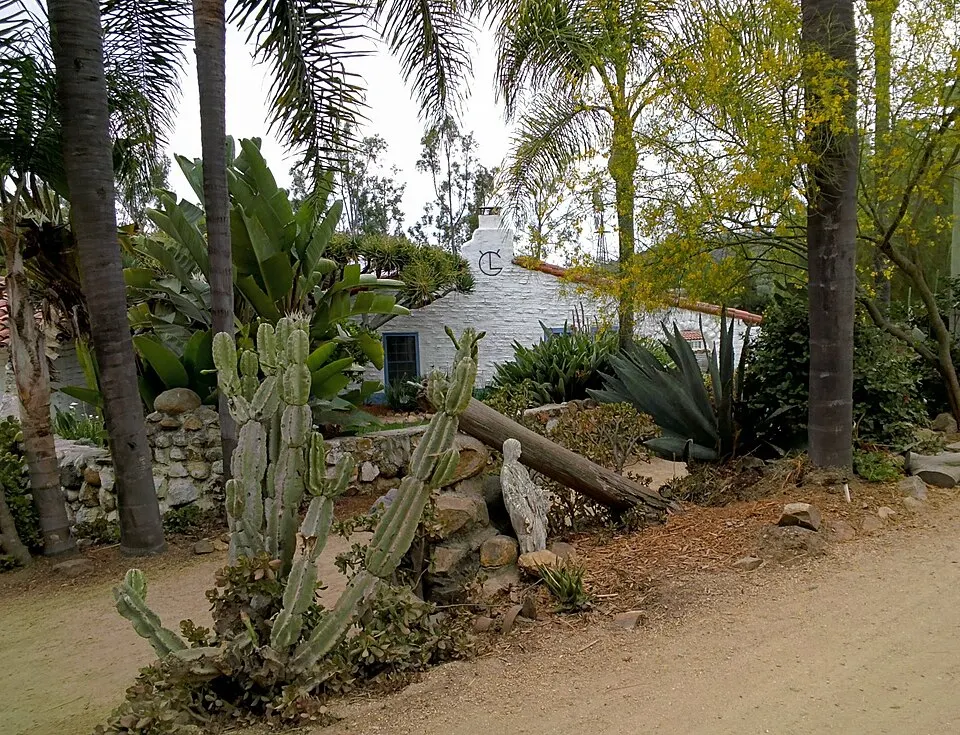
Leo Carrillo Ranch Historic Park occupies land originally called "the Quiotes" by Mission Indians, referring to the yucca plants growing on the surrounding hills, and homesteaded in 1869 by Matthew Kelly[5]. Actor Leo Carrillo purchased the original 1,700 acres in 1937 and added another 838 acres two years later, building a rambling adobe hacienda inspired by early Californio ranchos[6][5]. He called the property "Rancho de los Quiotes," or "Ranch of the Spanish Daggers," using a Spanish spelling of the local yucca name[5]. The Carrillo family used the ranch from 1937 to 1978, and Carrillo, who also served 18 years on the California State Beaches and Parks Commission, hosted large gatherings there[5].
In 1960 about 1,000 acres were sold to developers for a residential subdivision, and the sale of the remaining acreage in 1976 included a deed of 10.5 acres, comprising the historic buildings, to the City of Carlsbad[6]. A later transfer of 16.4 acres expanded the park to its current 27 acres[6][5]. The property was added to the National Register of Historic Places in 1992, and the park opened to the public on August 16, 2003[6][5]. In 2019, Coastal Sage Landscape Architecture reconstructed sections of the corral and added a network of pathways[6]. Leo Carrillo Ranch Historic Park is also designated a registered California Historical Site, and the nearby Rancho Carrillo Trail is named for the actor[11].
Other historic sites
Near the Alt Karlsbad site is St. Michael's Episcopal Church, described in 1987 as Carlsbad's oldest place of worship, a redwood chapel built in 1896, and recorded elsewhere as St. Michael's By-the-Sea Episcopal Church, built in 1894[4][7]. Also nearby is the Carlsbad Mineral Springs Hotel, which opened in 1930 and later became a retirement home[4]. A 1987 Los Angeles Times article also described the Army and Navy Academy, a college-preparatory boarding school, as a Carlsbad landmark for 51 years at that time[4].
Common questions
Why is Carlsbad named after a European spa town?
Water from a well drilled by John Frazier in the early 1880s was found to share chemical properties with the water of the Karlovy Vary (Karlsbad) spa in Bohemia, leading the town's founders to adopt the anglicized name Carlsbad[4][3].
What is Alt Karlsbad?
Alt Karlsbad is a replica German Hanseatic-style building on Carlsbad Boulevard marking the site of Frazier's original mineral well[1][4].
Is the Santa Fe Depot still used for trains?
The original 1887 depot building was used by the railroad until 1960 and now serves as a visitor center; current rail service runs from the nearby Carlsbad Village station on the NCTD COASTER line[2][8].
Who was Leo Carrillo?
Leo Carrillo was a Hollywood actor, known for playing "Pancho" on the Cisco Kid television series, who purchased ranch land in Carlsbad in 1937 and built an adobe hacienda there[5][11].
Are the Twin Inns and Magee House related buildings?
Both were homes built by founders of the Carlsbad Land and Water Company—the Twin Inns from Gerhard Schutte's house and the Magee House from Samuel Church Smith's house—though they are located in different parts of town[7][3].
Related topics
- History of Carlsbad
- Frazier's Well and Carlsbad mineral water
- Incorporation of Carlsbad (1952)
- Carlsbad Village
- Notable people from Carlsbad
- Transportation in Carlsbad
- McClellan-Palomar Airport
- Attractions in Carlsbad
References
All sources retrieved November 2026.
- ^ a b c d e "Carlsbad, California (Wikipedia)". Wikipedia. Retrieved November 2026.
- ^ a b c d e f g "Carlsbad Village station (Wikipedia)". Wikipedia. Retrieved November 2026.
- ^ a b c d e f g h "Windowns on the Past - An Ilustrated History of Carlsbad, California by Susan Schnebelen Gutierrez -- 1880s and 1890s". Carlsbad Historical Society. Retrieved November 2026.
- ^ a b c d e f g h i j k l m n "The 100-Year History of Carlsbad - Los Angeles Times". Los Angeles Times. Retrieved November 2026.
- ^ a b c d e f g h i j k "cc_lcranch". City of Carlsbad. Retrieved November 2026.
- ^ a b c d e f g h i j "Leo Carrillo Ranch Historic Park | TCLF". The Cultural Landscape Foundation. Retrieved November 2026.
- ^ a b c d e f g "John A. Frazier (Wikipedia)". Wikipedia. Retrieved November 2026.
- ^ a b "Carlsbad Village station (Wikipedia)". Wikipedia. Retrieved November 2026.
- ^ "**COASTER** Commuter Rail". North County Transit District. Retrieved November 2026.
- ^ a b c "Between Germany and Carlsbad". San Diego History Center, Journal of San Diego History. Retrieved November 2026.
- ^ a b "Leo Carrillo (Wikipedia)". Wikipedia. Retrieved November 2026.